 |
| Friendly neighborhood police officer |
Today is Tuesday, January 21, 2014.
I had several interactions with the police (keisatsu) while in Japan, each of them providing a clearer picture of how they operate.
My first interaction was when I left my purse behind in a taxi in downtown Osaka. I had taken the taxi with my husband, and I realized immediately what I'd done, but the taxi had already sped away. My husband told me that we would have to wait until we got home to deal with it. I was particularly upset, not because there was a lot of money in the handbag. In fact, there wasn't more than about 4,000 yen, which in those days was worth considerably less than $15. Even 40 years ago, $15 wasn't that much, and it certainly didn't buy much in Japan, either. The thing that had me worried was that my Alien Registration Card was in my purse, and the law stated that all aliens were to carry their AR Card with them at all times. My AR Card went with me everywhere I went, which is why it is so beat-up looking. Fortunately, there was nothing else really personal in my purse. Maybe a handkerchief and a tube of lipstick, that's about it. In those days regular people didn't have credit cards or ATM cards, and stores didn't give out "reward cards" or "discount cards" the way they do in the United States. You carried cash, your AR Card, and your train pass or drivers' license. Most people carried lots of cash, since credit cards and personal checks were not in use in Japan at that time, but I didn't have to carry a lot that day, since I expected my husband to handle the expenses.
 |
The cover of my AR Card. In Japanese this is called
Gaikokujin Tōroku Shōmeisho. |
 |
Page 1. Name, sex, date of birth, nationality (They call the United States "Beikoku,"
which means Rice Country - rice being worth a lot of money, you know. Occupation
is "English Teacher". Passport number and issue date at the bottom. |
 |
Page 2: Port of entry was Haneda Airport in Tokyo, which is
only used as a domestic airport now. Date of original entry
was January 9, 1977. I think the authorized period of stay
was crossed out when I left Japan. It gives my place of
birth (Madison, SD) and my parents' address at the time,
then my address in Japan. The bottom part says I am the
head of household and my relationship to the head of
household is "self." On page 3, it gives my employer's
address. This AR Card had been issued in 1985 (Showa 60)
and the signature (red stamp) was that of the head of
Bunkyo-ku (ward), the section of Tokyo where I lived. |
|
 |
On page 4, my photograph and fingerprint. To the left of
the print, it says it is my left index finger. Foreigners always
hated being fingerprinted like a criminal. I was no exception.
|
|
In Japan, any non-Japanese who is not a citizen must carry this identification with them. It isn't really a card. It's a little booklet, like a mini-passport. Inside it tells your name, date of birth, sex, where you're from, where in Japan you work, your passport number and date of issue, when you first entered Japan and at what port, your foreign "home address" (I always gave my parents' address rather than argue that I didn't really have a home address in the United States), and the name of your "head of household" and your relationship to said head of household. It also told where you lived in Japan, as it if was just a temporary thing, not your permanent domicile. The document had a passport-style photo and the one thing that every foreigner hated: your fingerprint. There was a place to note which finger it was, too.
My husband called the taxi association, saying where we had picked up the cab and where we got off. It would have been quite easy for a dispatcher to ask all the cabs out on the road in Osaka whether they'd picked up a "foreign woman and a Japanese man" and ask them to check the back seat of their cab. Sure enough, our cabbie noticed my purse and took it to the police. We got a call from the downtown Osaka police station that my purse had been found.
So just go down there and pick it up, right?
Wrong.
I went there by myself with my passport (something you do not have to carry around, as long as you have your AR Card), and asked for my purse. They showed it to me and I said, "Yes, that's mine." I was shocked when they refused to give it to me.
 |
| Neighborhood police get around on bikes. |
The explanation was that I had not given the cabbie the required gift. In Japan, if you lose something valuable, you are, by law, expected to give the finder at 10% finder's fee. Since I hadn't lost that much cash, a 10% fee would have been ridiculous, so we were advised to send a bottle of whiskey. This is a standard type of status gift in Japan, and nobody questioned whether the cabbie drank or whether he would appreciate such a gift. It was just assumed that he would be thrilled to get a bottle of whiskey. And not a cheap one, either. We would have to spend at least 10,000 yen. At that exchange rate, it was only about $35, but that was beside the point. We were legally only obligated to pay the cabbie 400 yen, but socially speaking we were obligated to give him a nice gift. So much for 10%.
Well, we had ordered and sent the whiskey to the cabbie's home, having got the address from the police on the phone. The police always collect the address of the finder. However, the cabbie hadn't bothered to tell the police that he had received his gift. I had to go home and have my husband call the cabbie personally. The cabbie told my husband that he wasn't really from Osaka, that he was from a suburb, and had just been in downtown Osaka only because he'd taken a fare there, so downtown Osaka wasn't his normal territory. He had indeed received the whiskey but told us that it was too far for him to go all the way into downtown Osaka to inform the police.
My husband told him that his refusal to do this meant that I couldn't pick up my handbag. The man promised to talk to them in a day or two. I had my husband call the police every day until we were told that the cabbie had finally come in and signed a release form. Then I went to pick up the handbag. By the time I got it back, it was almost an anticlimax. The policeman at the desk sternly warned me not to lose my handbag again.
Duh. Certainly I would make an effort never to lose anything ever again, especially if it was this much trouble to get it back!
*** *** *** *** ***
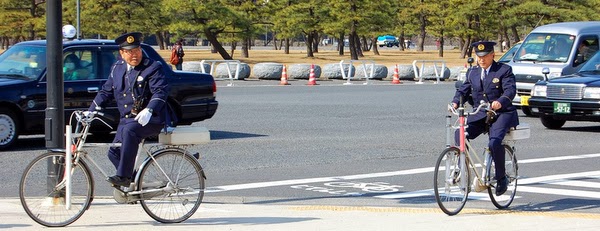 |
| A pair of police officers on official police bikes. |
My second interaction occurred at time when a friend of my mother's and her pre-teen daughter came to Japan to visit, and I agreed to "show them around." The woman had breast cancer, which was pretty much of a death sentence back then. She had decided on "one last trip" with her daughter to a place she had always wanted to visit. It was her way of spending quality time with her daughter before she died. One thing that struck me was that neither one of them had a camera or wanted to take pictures. I knew the woman didn't care about pictures, because she knew she wouldn't need them, but I wondered why the daughter didn't want to take pictures to remember her mom. At any rate, I agreed to give them the full tour while they were in Osaka.
 |
| Police bikes, parked. |
Their flight arrived in Tokyo, and I knew that they planned to spend a couple of days there, first. I also know what hotel they were planning to stay at, and when they planned to take the Shinkansen Bullet Train to Osaka. Part of the problem was that a political summit meeting was being held in Tokyo, and the Japanese police and customs authorities had gone into security overdrive, as the leaders of several nations were in Japan's capital city all at once. The police and customs officials were taking no chances, and they were checking out everyone's story.
I got a call at what would have been about 45 minutes after their plane landed in Tokyo.
"This is the Sakai-city police. I'm calling for Linda Matsuda," said a brusque male voice. I assured him that I was the person he was looking for.
"Are you expecting a guest?"
"Yes."
"How many people?"
"Two."
"What are their names?"
I gave their names, and the spelling of the names.
"Are they planning to stay with you?"
"Yes, but not today. They are staying at the _____ Hotel in Tokyo tonight and tomorrow night."
"When will they arrive?"
"I'm going to pick them up at Shin-Osaka Station from the Bullet Train. They will call me before they leave their hotel." (In those days, there were no cell phones. I had told them explicitly how to use a pay phone, but didn't know if they had any coins yet. Some of you may know how hard it is when you first get to a foreign country, even if you have already exchanged your money for the local currency, because there are some things that you can't do with bills. You have to have coins. And for that, you have to spend some money.)
"How long will they stay?"
"They'll be here for four days, then they're going back to Tokyo."
"All right, thank you."
Keep in mind this was my local police who were calling, not the ones in Tokyo. That means that my guests' information had gone from the customs office directly to my local police in a very short time, and most probably also to the Tokyo police, who no doubt confirmed with the hotel where they were staying. My guests were being watched six ways from Sunday, and so was I.
 |
| Japanese police car |
*** *** *** *** ***
 |
Very old-style koban near the Imperial
Palace in Tokyo. |
When I moved to Tokyo by myself, I sublet a very small condo from a lady whom I never met in person. I simply sent my rent to her every month by genkin kakitome, "registered cash delivery," which was a service provided by the post office. You put your cash in an envelope, then sealed it with a special stamp that you paid for, and they would deliver the money to the person. The post office gave the sender a receipt, and if the addressee never got the money, the post office would be responsible for it, so they made sure it was securely delivered. It was a good system. But I digress...
I rode the subway every day to work at the Yaesu Branch of the Berlitz Schools of Languages, Japan. That was only a few short blocks away from the newer Yaesu entrance of Tokyo Station. At work, I met a lot of foreigners who were also teaching English, and one of them was a fellow named Joe from Minnesota. Joe was married to a Japanese girl, and they lived with her parents. He was working as hard as he could in order to go back to the United States.
Whenever foreigners left Japan, they would get rid of a lot of stuff, and that is how I ended up with some of it. I used to drive a pretty hard bargain, since the people were always in a hurry to get rid of their "stuff," and they knew that they would be charged an arm and a leg to have it taken away to a public dump. I picked up a washing machine this way and sold it to someone else when I left. I also picked up various pieces of furniture and other assorted useful items. But from Joe, I bought a woman's bicycle that had belonged to his wife. It was a good bike, and I rode the heck out of it, all over Tokyo.
Very soon after I bought the bike, I was transferred to the Aoyama Branch School, a little farther away from home than the Yaesu Branch. I quickly figured out on a map how I could get to work on my bike and started to ride to work. I really loved riding my bike to work in the summertime. I would just put on a pair of shorts and a tank top, with my dress clothes in a bag. I would sponge the sweat off my body in the bathroom at work and dress, putting my shorts in my locker. There are plenty of bike racks all over Tokyo, and it was easy to get a bike lock from a hardware store. On cooler days, I just rode my bike in my skirt, my only adjustment to the bike being a pair of tennis shoes that I exchanged for heels when I got to work. (I had no idea that Yuppie women were doing this regularly in the United States at the time – this was the early 1980s.)
 |
Modern koban somewhere in Tokyo. I notice that they
have taken to marking them using ABCs, so even
foreigners can see what they are. That's an improvement
over when I was in Japan. |
My path to and from work took me around the outer moat of the Imperial Palace each day. You have to understand that although English language schools like Berlitz did have some students during the day, their prime time for giving lessons was in the evening, after work. Most days, I worked evenings until closing time, which was 9:10 pm. (Each Berlitz lesson was 40 minutes long, and the last lesson began at 8:30 pm.) By 9:20 or so, I was out of there and pedaling home. I can't remember how long it took, but I was probably home between 10:00 and 10:30. Biking home didn't save me any time from taking the subway. It was just nicer, as long as the weather cooperated.
I hadn't been working at Aoyama that long, and this may have been only the first or second time for me to ride home on my bike. For some reason, I had stayed out later than usual that evening, probably having gone out with some friends after work, so it must have been close to midnight when I rode past the main police box in front of the Imperial Palace. A police box, or koban, is a very small office for local beat policemen. There's at least one in every neighborhood, and the Japanese police are pretty good at keeping tabs on people in their own local neighborhoods. Koban are very small offices, with room for no more than about four people, max. Around the Imperial Palace, there was one every few hundred yards or so. I passed at least three of them on my way around the palace.
When I moved into my place in Tokyo, I got a visit from a white-gloved local policeman, asking me to fill out a little information on a little green card. The man seemed friendly and helpful, and I gave him the information he wanted and thought no more about it.
 |
This particular photo had a map attached, so I think
it was the very police station where I was stopped. |
Now it was midnight and I was being stopped by a police officer, who stood in the middle of the sidewalk and motioned me to get off my bike. Was I riding too fast? Did they smell beer on my breath? Well, at least I had my AR Card with me.
I stopped and gave the officer my AR Card as requested.
"Why are you here so late at night?"
"I work at the Berlitz School in Aoyama. I teach English there. My work ended at 9:10, then I went out for dinner with some friends."
"This says you work at the Yaesu Branch."
"I know, but I got transferred. Berlitz has a lot of branches in Tokyo."
"Where is this Aoyama Branch?"
I gave the address.
"What's the phone number?"
I gave it to him, but sold him that the school was closed for the evening. I'm sure he must have used it to confirm my story later.
"Where do you live?" That information was listed in my AR document, but I reeled off my address. Then he made a phone call, presumably to the police box nearest to the address I had given him. They confirmed that I did indeed live where I said I did, so that little green card I had filled out had been useful, after all.
While the officer made his call, I looked around and noticed in alarm that when I had been stopped, there were only two police officers, but now there were something like fifteen, all standing there silently gawking at me. The officer finished his call and turned to me.
"So how do you usually bike from Berlitz in Aoyama to your home?"
I explained my route.
"Are you usually out this late?"
"No, I have different hours each day, but my work ends at 9:10 at the latest. Sometimes I go out for dinner with friends, but most of the time I come right home."
"I've never seen you before."
"I haven't ridden to work much before now. I haven't had the bike that long."
"Whose bike is that?"
"Mine."
"Where did you get it?"
"I bought it from a friend."
"Who is this friend?"
"His name is Joe Palumbo. He's married to a Japanese, but he and his wife left Japan a few weeks ago. I bought the bike from him before he left."
"Where does he live?"
"I don't know. Somewhere in the United States. In Minnesota."
"Where did he live in Japan?"
"He lived with his wife's family."
"What are their names?"
"I don't know."
"Where do they live?"
Thankfully, I still had a phone number for Joe written in my address book, which I had with me. "I don't know, but I have their phone number." I dug out my address book and gave them the number, hoping that they could just confirm it and let me go. Oh, no, that would have been too simple. They had to call the number!
"It's midnight, they're probably sleeping," I protested, frightened that some older couple was about to get a call from the police asking about their American son-in-law.
Fortunately, someone answered the phone and confirmed that, yes, they had a daughter and that she was the wife of a foreigner, that their daughter and her husband had just left the country, and that, yes, their daughter had sold a bicycle to another foreign lady.
The policeman still had my AR Card. "You haven't updated this card. It's out of date."
I knew why he was saying this, because there had been a change in the law very recently. Foreigners who lived in Japan no longer had to update their cards quite so frequently, and we had been advised that even if the card was out of date, we were to wait the newly-prescribed amount of time before applying for a new one.
"The law has changed, sir," I said. "I don't have to get this updated until next year."
At this point, some of the officers were smiling, and a couple were obviously holding back a snicker. One of the guys said, "She knows more about it than you do."
Embarrassed, the officer decided not to press me any further. I was advised to paint my name and address on the fender of the bike, which I did later, and I was told very sternly to be careful I got on my bike and rode home, grateful that nothing worse had happened.
 |
An ordinary neighborhood police box, with
living quartersfor the officer and his family
above the box. |
After that episode, I noticed that every time I got to the road around the Imperial Palace, the guys at the first koban I passed would smile and nod, or maybe wave or salute and then pick up the phone. I knew they were calling the next koban to advise them of my arrival. I would wave to the guys on duty at the second and third boxes before leaving the street surrounding the palace and heading along the street that led to my home.
Interestingly enough, I see now that my home address was written incorrectly on my last AR Card, which I was allowed to take with me. (All the other times I had left Japan, I intended to return, so my AR Card had been surrendered and returned to me when I arrived back in Japan.) If I had stayed much longer, I probably would have gotten into some scrape or other and would probably have had to prove that I lived at 1-5-10-403 instead of 1-5-15-403. Oh, well, I'm glad I never did have to deal with that. I see that I never updated my place of work, either. It still says Berlitz Yaesu Branch. I would have had to talk my way out of that one, too.
*** *** *** *** ***
 |
| A white-gloved policeman on duty. |
My last interaction with the police was frightening, but the police were not what frightened me. It was Easter Sunday, 1986, which fell on March 30 that year. The weather had been OK during the day, but it was chilly and drizzling a bit that evening. I had decided to attend an Easter worship service at a certain Protestant Christian church where a lot of foreigners gathered, because I knew that they always invited members of the audience to sing the Hallelujah Chorus from Handel's Messiah. I knew that song backward and forward, so decided to go and sing. I dressed in my best for the service.
After the service, I was invited out to the home of foreign friends who lived in Kawasaki. I had brought some casual clothes with me in a shopping bag, and changed when I got to their apartment. I spent the day with them, and left for home on the last train. I knew that if I got on the train that left at 10:30 or so, I would get home by midnight.
I had my shopping bag full of dress clothes, a black umbrella for the drizzle, my purse, and my SONY Walkman, which I was listening to as I walked from the subway station to my apartment. I lived on the fourth floor, and I remember noticing that the elevator had last stopped on the fourth floor when I called it down. When the door opened, I had the shock of my life. Keep in mind that this elevator had an automatic light that went off when the elevator was not in use. (I found that out one day when I got into the elevator and absentmindedly forgot to push the button of the floor I wanted.)
OK, so I called the elevator down from 4th floor and when it arrived on the ground floor, the door opened. Inside was a young man, stark naked, with a woman's nylon stocking over his head. He was holding his hand in front of his private parts. It was bizarre!
The man slowly advanced toward me, and I remember the stupid music from the Walkman blaring in my ears as I held my closed umbrella in front of me, ironically just like a Japanese sword, to keep him at bay. I had to think fast, and what I decided to do was just dash past him, run inside the elevator, hit the "close" button, and hightail it to fourth floor. I ran to my apartment and locked myself inside.
As I was locking the door, I looked out the peephole and saw that this monster had followed me to my apartment, probably by climbing the stairs. I banged on the metal door to make a noise that might alert my neighbors, and shouted to him that I was going to all the police. He turned and fled.
Fortunately, my curtains were closed, so he couldn't see inside my apartment. Shaking, I talked myself into calling the police.
"I'm a foreigner and I don't speak Japanese very well," I said, "but I'm going to tell you what I saw."
"All right, start by telling me your name."
I gave him my name, my address, and then started to tell him what happened. I emphasized that the man was naked and that he'd been wearing only a woman's nylon stocking over his head.
The officer was skeptical, but he kept me talking. "Did he say anything to you?"
"No."
"Did he hit you? Did he touch you?"
"No."
"Did he threaten you?"
"No."
"Then why are you calling?"
"You don't understand! I told you, there's a naked man running around in my neighborhood! You have to find him!"
"All right, you just sit tight. I'm sending two officers to your place. When they knock, you answer the door, but not until you see policemen outside, OK?"
I agreed. No sooner had I put down the phone, when I heard the doorbell. I peeked outside, and sure enough, there were two white-gloved officers.
I went outside to talk to them.
"What did he look like?"
This is a hard question. I'm not the kind of person who says all Japanese look alike, because that's not the case, but I hadn't really learned how to describe an individual's appearance very effectively. And I hadn't really had a very good look at the guy's face.
I told them how tall he was, that he had dark hair and looked like a Japanese guy with a slim build, maybe in his 20s or 30s. That's all I could tell him. Obviously, I couldn't tell them what he was wearing, because he hadn't been wearing anything.
Except the stocking.
The police confirmed my story and told me to stay locked inside my apartment that night. Then they saluted and were gone.
That night I called my parents and told them I was coming home, for good. They had called me not long before this incident to tell me about a possible job teaching Japanese at a school in Oregon. At the time I'd said I didn't think I could really do that. Now, the thought that I might have a teaching job in the United States, even though I had no teaching credentials, was exciting.
The police never did tell me whether they found the guy, and I later realized that it might have been a very nutty neighbor of mine from upstairs, who I think had some sort of sexual fantasy about me. I still think it's totally bizarre that a man would stand naked in a cold elevator at midnight with a woman's stocking over his head on the off chance he might meet up with the object of his stupid fantasy.
I made plans to visit the United States as soon as possible, and about six weeks later, I met my parents at my brother's place in a suburb of Seattle, Washington. (They had flown there from Minnesota.) My dad drove mom and me down the coast to Oregon in my brother's SUV, where I interviewed for a job with a fellow that my father had known in university. We drove back to Oregon, then I flew with them to Minnesota, where I had one other job interview with the Minneapolis Public Schools, also for a position teaching Japanese. I was offered both jobs, but decided to take the one in Oregon. I flew back to Japan for the last time, to wind up my affairs there and pack for the journey home. :-)


