Wednesday, May 29, 2013

One Person Can Make a Difference

Today is Tuesday, May 28, 2013.

Many of us are accustomed to thinking that what we do as individuals can't possibly make a difference in the world, but with the power of the Internet behind us, it's getting easier than ever for a small group, or even one person, to take action that can generate significant change.  All it takes is one person with an idea and a few connections, and suddenly, things happen.  Maybe you can't change the lives of everyone on the planet, but changes tend to have a ripple effect, so even if you change only one other person's life, you will have done something.  The trick is to get started.

History has recorded many men who have made a difference, among them Mohandas Gandhi, who is known by the title, Mahatma, a Sanskrit term of respect that means "Great Soul."  Gandhi (1869-1948) led the people of India in a movement toward independence from Great Britain that was based on nonviolence and civil disobedience.  Not only did he change the lives of the people of India, he also influenced Dr. Martin Luther King, Jr. (1929-1968), who led African Americans in the American Civil Rights Movement.  

I'd like to highlight a few women who have made a difference, and some children who are now making a difference.

Juliette Gordon Low (1860-1927) founded the Girl Scouts of the USA, which has had a positive effect on many girls in this country, myself included. 

Florence Nightingale (1820-1910), the founder of modern nursing, served in the Crimean War and later established the first secular school of nursing in the world. Not only did she improve health care in England, she also advocated for hunger relief in India and helped to make nursing an "acceptable" occupation for women.  Without her influence, my mom might not have become a nurse.


Oprah Winfrey (1954–  ) is often cited as one of the most powerful women in the United States, largely due to her afternoon talk show, on which she encouraged her audience, largely made up of women, to read good books, improve their lives, and explore spirituality.  With all the money she's earned on TV, she has also been able to help young girls in Africa get a good education.  CNN did a report on 10 people we wouldn't know without Oprah Winfrey.  The list includes Dr. Phil McGraw, and Dr. Mehmet Oz, and her personal trainer, Bob Greene.  Gary Zukav, author of a number of books on spirituality, rocketed to fame as a result of his appearance on Oprah's show.  Oprah has opened up public discussion of a number of topics that used to be taboo.

Katie Couric (1957–  ) is another TV personality who has had a lot of influence on the American public.  Many remember her work on 60 Minutes and The Today Show, but she will probably go down in the history books as the first female solo news anchor on The CBS Evening News.  One of the most courageous things Couric did was to have a colonoscopy done on live TV.  The procedure was watched by millions, and resulted in a 20% spike in colonoscopy procedures in the years that followed.  Michael Kreines, MD, a gastroenterologist, stated in a news article, "Many lives have been saved by people inspired by Katie's live demonstration that a colonoscopy is not uncomfortable or embarrassing."

There have been a number of women through the years who have changed lives even though their names are not generally recognized.  Josephine Cochrane (1839-1913) is one.  Believe it or not, she invented the first practical mechanical dishwasher in 1886, and presented it at the 1893 World's Fair. The next time you pop your dishes in the dishwasher, give Josephine a thought.

There have been some great reports in recent years on kids who have had an impact.  They include Abigail Lupi, 10, who sang for her great-grandmother's 100th birthday at an assisted living center and realized that a lot of old folks don't get many visitors.  Now she leads an ensemble of 13 girls ages 6 to 13, who have performed for the elderly at 20 different locations with a repertoire of 90 Broadway and pop songs. 

Charlie Coons, 13, was shocked to hear her big brother tell stories about conditions in an orphanage in Jordan, where he had volunteered.  She decided to make fleece blankets created from kits, and invited her friends to help out.  They shipped their first 50 blankets to the orphanage in Jordan.  Her father, a Rotary Club member, lined up speaking engagements for his daughter, who spoke about an organization she had created to raise money for more blankets.  Her group is called HELP (Hope Encouragement Love Peace).  HELP has sent 700 blankets to nine nations with the help of some international children’s groups. 

Winter Vinecki, 12, is a runner who has raised thousands of dollars for cancer research.  She realized that she could raise even more by competing with a team in races and triathlons.  In 2008, her father was diagnosed with prostate cancer.  Winter was only 9 that year, but she swam, ran, and cycled her way through a triathlon with members of "Team Winter" to raise over $100,000 for prostate cancer treatment and research.  Unfortunately, Winter's dad died less than a year after his diagnosis, at the age of 40, but Team Winter has continued to raise awareness and money for research.  The team now comprises 200 athletes, who have helped to raise over $250,000 for prostate cancer research and treatment. 

There are boys, too, but I wanted to focus on girls, for a change.  With so many wonderful people like these in the world, we are indeed blessed.  I hope many more young  people will be inspired to make positive changes in the world.  :-)


Tuesday, May 28, 2013

Getting Stuck

Image credit: DOE archives/photo Ed Westcott
Today is Monday, May 27, 2013.

When the weather's gray and stormy as it has been for a few days, now, it's easy to fall into the doldrums.  My life is going pretty much as it should, right now, but there is one area in which I feel a little stuck, and that's my effort toward weight-loss.  I think I can beat the problem, though, so I'm not going to go on and on about losing weight.  Instead, I decided to investigate a situation that all of us have faced at one time or another: feeling stuck. 

I would guess that most people feel stuck in their job at one point or another during their working life.  I certainly did, even though I love teaching.  I just wasn't teaching in the right place anymore.  I was just incredibly lucky to be offered a way out without too much effort, and while I'm eternally grateful for this, I wonder if I might have been able to learn more about getting out of a rut on my own if I'd had to work it out for myself.  That's one thing we'll never know.  However, I do have an opportunity, now, to blog about the issue, which may end up being of some help to myself in the future, or perhaps to one of my readers.  Who knows?

If you've ever been stuck in a rut, you know how it feels.  Energy just seems to drain right out of your body, and you can't seem to get excited about much of anything.  Even little tasks seem difficult and small problems seem insurmountable.  You get upset over things that normally might seem insignificant.  Your options seem limited, and there doesn't seem to be any way out of the tunnel you are in.  It's hard to focus on anything in particular, and you can't even envision what it is you want.  If you're spiritually inclined, you can't seem to find that connection with the Divine that has uplifted you in the past, your dreams seem to have dried up, and you are too restless to get into a meditative state. 

In tough economic times, this stuck feeling is complicated by the fact that jobs just aren't that plentiful, and if you are lucky enough to have a job, you feel as if you might be jumping from the frying pan into the fire if you give up the job you have.  Then there is your responsibility to your family, if you have one, that keeps you from quitting a job that keeps bread and butter on the table.  If you're like most Americans, you are probably also in debt: you have house payments, car payments, credit card payments, or other loan payments to think about. 

If you're stuck in a relationship that's going nowhere, you may be worried that you could never support yourself all alone, or that you could never learn to do things for yourself.  You may even be afraid that no one else would have you, or that life would be unbearable without someone to spend Saturday night with. 

In order to get unstuck, it helps to know how you got stuck in the first place.  The answers cannot be found by looking around you.  They can only be found by looking within.

The major cause of being stuck is fear, pure and simple. Specifically, people who are stuck are afraid of the future.  They're afraid of the unknown.  They're afraid of change.   Why?  I would say the biggest problem with "the unknown" is that people are afraid they won't be able to handle it, that they won't be up to the task.  That is tied in with low self-esteem and lack of confidence, and that has to do with our subconscious beliefs about ourselves.  (I'm a failure, I'm not smart enough, etc.)  In earlier blog posts, I've written about re-programming your subconscious beliefs.  In order to do this, you do have to delve into your innermost being and identify the beliefs that are causing you problems, and you have to be hyper-aware of your self-talk.  For example, how do you scold yourself when you spill something or miss an appointment?  How do you feel about yourself when you do poorly on a test or when you underwhelm your boss in a job performance review?  Those things you think or say to yourself – that's your self-talk, and those are your subconscious beliefs. 

Besides fear of the unknown, there are all kinds of known outcomes that scare people. You might go bankrupt or lose your home.  You might fail in front of the whole company.  You might disappoint your loved ones.  Well, yes, you might, but it's a fact that 90% or more of the things that people worry about never happen.   The vast, vast majority of things I've worried about in the past have not even remotely come true.  Even the times when I wasn't totally successful, what did happen wasn't nearly as bad as I had feared.

What if your worst fear does come true?  Frankly, if your fear is that strong, it just might. Those of us who have fallen on our faces once or twice know something that others don't.  We know that you can pick yourself up and go on.  That's the most valuable lesson I have learned in life.  Whatever happens, I can get through it.  I will come out on the other side, somehow, because I did it before.

Taking the time for introspection and meditation is essential to overcoming our fears.  It's also important to be mindful of our self talk and consistent in rooting out negative thoughts and replacing them with positive ones.

A wonderful book that can help you work with the fear of change is one by Mary Carroll Moore, called How to Master Change in Your Life: 67 Ways to Handle Life's Toughest Moments.

We get stuck when we dwell too much on the past.  Sometimes we replay a past experience over and over, wishing we had reacted differently, and knowing that what we did then has landed us in the mess we are in today.  It's easy to think that the show is now over, that we blew our chance, and that we will never have another opportunity.  This seems to happen a lot when we lose a job or when a relationship breaks up. 

I wish I had fifty dollars for every person in my life who told me that they would never find another job as good as the one they lost, or that they would never find someone else to love.  I wish I had another fifty dollars for every person who found a better job and a much more fulfilling relationship after that.  I could take a nice little vacation to Hawaii with all that money. Truly, when one door closes, another one opens.  It's hard to remember this when a door has just been slammed in our faces, but it's a good thought to hang onto.

There's nothing wrong with looking at something that went amiss to see what mistakes we made, but once that's done, it's important to let it go and move on.  Of course, we also have to find a way to avoid that same mistake in the future.  That's what makes tough situations so valuable – learning how we can do better next time.

We get stuck when we look for fulfillment in the wrong place.  A majority of people still think they can find happiness outside of themselves.  They think if they had high-paying job with a prestigious title, they would be happy.  If they had a little more money or got out of debt, they'd be on easy street.  If they could just get that book published, or win this award, if they could find the perfect relationship, get their beloved to propose marriage, or have a child, everything else would fall into place.  If they could just lose a little weight, recover their energy after an illness, tone up their flabby muscles or find the perfect hairstyle, their life would be on track.  If they wore more fashionable clothes, drove a better car, or lived in a more upscale neighborhood, things would be different.  Sure, they might be happier for a while, but then the doldrums would come back.

Thinking that things outside of ourselves will make us happy is what keeps us in the so-called "rat race."  It's the ball-and-chain that holds us in place.  This kind of thinking is also what makes smokers smoke, what makes drinkers drink, what makes drug-users do drugs, and what makes gamblers gamble.  These addictive behaviors are all part of the rat race.  For that matter, it's what makes people eat too much food and drink too much coffee. 

Abe Lincoln said, "Most people are about as happy as they make up their minds to be."  Happiness has nothing to do with what you have and everything to do with what you are, and what we forget is that we can change what we are.  

We get stuck when we believe that our situation is just "the way it is" and that it can't be changed.  The Declaration of Independence addressed this type of thinking:  "...mankind are more disposed to suffer, while evils are sufferable, than to right themselves by abolishing the forms to which they are accustomed."  In other words, we think we can't change the situation, so we don't even try.  This type of thinking is a prison of our own making.  This is only one of the "attitude" problems that people have when they are stuck.  It's been said that if you don't control your attitude, then your attitude will control you.  Remember that your attitude is determined by your subconscious thoughts.  Carl Jung is supposed to have said, "Until you make the unconscious conscious, it will direct your life and you will call it fate."  Even if he never did express it exactly in this way, I believe he would have agreed with the statement. It takes a conscious decision o make a change, and it takes grit and perseverance to make the change happen.  The key is realizing that your life doesn't have to be the way it is now forever.  You can make things change.

We get stuck when we are unwilling to confront obstacles and avoid hard work.  This is another attitude problem.  If you're thinking that other people have it easy, you're mistaken.  No one has it easy, even if they make it look easy.  In fact, human beings are programmed to solve problems and overcome challenges.  That's what we're all here for.  That's why Souls come into this physical life.  What makes a good book good?  The hero or heroine triumphs over adversity of some kind.  What makes a great life great?  Same thing - triumph over adversity.  No experience in this life is a waste of time if we can learn from it.  As Soul, we didn't come here to be successful or to have an easy life.  We came here to hone one or more qualities that we had trouble manifesting in the past. We came to learn just how powerful and creative we really are. 

We get stuck when we fail to be grateful for what we do have.  I can't prove this scientifically, but it seems to me that when we stop being grateful, life stops giving us things to be grateful for.  We have to cultivate an "attitude of gratitude" in order to move ahead.  When we do this, we are able to put our problems into proper perspective, and some of the obstacles we are facing seem a little less daunting. 

We get stuck when we fail to take total responsibility for our lives.  This is a biggie. Sure, we were dealt some cards to play with in this lifetime, but as Soul we agreed to the hand we were dealt.  These things can't generally be changed.  Your race, ethnicity, culture you grew up in, your birth family are things that you cannot change.  Sure, some people have had a sex change, but that's a very rare event.  Basically, you are born into a certain situation and those are the cards you are dealt.   As Randy Pausch said in his Last Lecture, "We cannot change the cards we are dealt, just how we play the hand."  How we "play the hand" is the sense in which we create our own reality. 

If we blame all our problems on someone else, then we are investing in that person the power to make things better for us.  If they don't take action to make things better, than we suffer.  If we admit that we created our own problems, then we can decide what we did to land us in our current mess, and we can figure out what it will take to get us out of it.  We are the ones who have to do this.  That's not to say we can't have help – we can.  But we are the ones who have to get the ball rolling.  Even if help is handed to us on a silver platter, we are the ones who must accept the help.  The world is full of people who cannot or will not accept help from others – just another example of how we create our own reality!

One thing that keeps us stuck is being in debt, and most people refuse to accept the fact that their own decisions got them into debt.  OK, so you bought a house or a new car.  Did you really need to buy that house when you did?  Could you have stayed in an apartment for a little longer?   Did you really need that expensive a car?  Was it really necessary to take that vacation?  One of the best things I can suggest to anyone who is feeling stuck is to find out how to get out of debt.  Suze Orman's books were incredibly helpful to me in this respect, and one of the best pieces of advice I ever got was to find a reputable debt consolidation plan and stick with it.  In only five years, I got out from under a mountain of debt, and I learned a lot of good habits to substitute for the bad ones that got me into financial trouble.

We get stuck when we ignore our true calling in life.  People who are feeling stuck often find that they have been trying to please someone else, perhaps their parents or their spouse.  They have been evaluating their lives by the standards of society.  They have been living lives that seem respectable or successful to others, but unfulfilling to themselves.  They are afraid to make a change because they might fail.  Or they are afraid that pleasing themselves might be considered self-centered.  They fail to realize that they can't very well be of use to others if they continue to deny themselves happiness.

It's been suggested by any number of psychologists and life coaches that you sit down and just write down what makes you happy, what makes your heart sing, what you'd like to do if time and money weren't obstacles.   One lady suggested to try listing 100 things you want to do in only 20 minutes.  Even if you don't get to 100, you will still have some ideas.  The trick is to go back to the list later and pick out one or two things that seem doable and do them. Even if the thing that makes you happiest doesn't turn out to be a moneymaker, you can at least be happy.

We get stuck when we fail to ask for and accept help.  I mentioned this above, briefly. Some people don't even recognize help when it is offered.  Others realize they are being offered help, but they are too proud or too ashamed to accept it.  A great many people have no idea how much potential help surrounds them in the spiritual realm.   When we ask for help from a Higher Power, whatever we understand that to be, things start to happen.  We start to meet the right people, we find ourselves in the right place at the right time, or we find a book or a health remedy that can help us.  Creation, itself, is primed to provide us with all the help we will ever need, if we will only ask. 

There's a certain trick to asking for help, though.  Help doesn't always come in the way we expect it.  For example, if you have just been through a divorce, you might wish to meet someone new right away to end your loneliness and make you feel better about yourself, but God might have a bigger plan.  Maybe you're supposed to start that business you've always wanted or get that book published, instead, and a relationship would just be one more burden to carry while you are trying to accomplish that.  

Instead of telling God how you'd like to be helped, think of qualities you'd like to have in your life.  More energy?  More joy?  Peace of mind?  A chance to help others?   That's what you should ask for.  Then let God fill in the blanks to give you just what you need to fulfill your desires.  Trust that a way will be provided, and resolve to accept the help in whatever form it comes.  :-)

Sunday, May 26, 2013

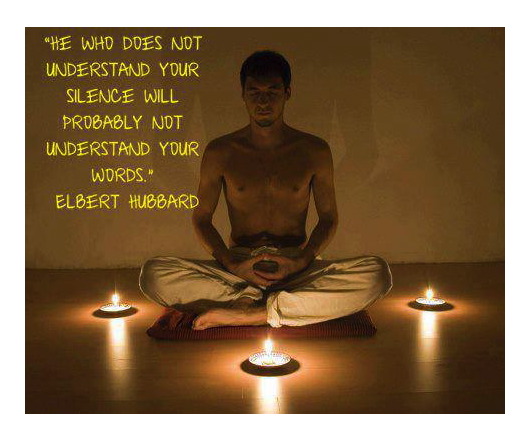
The Sound of Silence

Today is Sunday, May 26, 2013.

I'd like to talk about silence, today.  That may seem like a bit of an oxymoron, but here goes, anyway.  When I'm finished, I promise to be silent.

There are all kinds of reasons to be silent or not to be silent.  I do believe that it's important to speak up when we see injustice and impending danger, but I'm not talking about that sort of situation.  Rather, I'm talking about silence as a spiritual discipline.   All the world's major religions, plus a few others, have something to say about silence as a spiritual practice. 

A wise man in Islam said, "Wisdom consist in keeping silent, and those who practice it are few."  The Dalai Lama, the spiritual leader of Tibetan Buddhism, said, "Sometimes one creates a dynamic impression by saying something, and sometimes one creates as significant an impression by remaining silent." 


 Perkey Avot, which could be translated as Chapters of the Fathers, is a compilation of Jewish ethical teachings from Rabbis of the Mishnaic period.  It states, "Tradition is a safety fence to Torah, tithing a safety fence to wealth, vows a safety fence for abstinence; a safety fence for wisdom..... is silence."

Christianity also advises silence in a long list of situations, including when you are angry or critical, when you don't have all the facts, or when you haven't verified someone's story.  The Bible also advises silence when you might offend a "weaker" person (e.g. someone who is unable to accept some bit of truth), when you might convey the wrong impression, when yo u are tempted to tell a lie, when your words might damage a friendship, when it's none of your business, when you are supposed to be working, or when you have already said something more than once. All these might be considered instances of "outer silence."  If you are interested in reading the full list, click here.

The Quakers (Religious Society of Friends) actually make silence a part of their worship service.  They feel that it is important for each individual to be silent in order to hear the "still, small voice of God."   They take the Psalmist's advice to heart, literally: "Be still, and know that I am God." (Psalm 46:10)  Although it is an outer silence, it is a little closer to the Hindu and Buddhist views, which focus on something called "inner silence."

Inner silence, or inner stillness, is learning to quiet that "chatterbox" inside our heads who seems to have a comment on every situation that we experience in our lives.  This is the silence that we cultivate in meditation. When we leave behind that pesky voice, what we are really letting go of is our need to frame our experience in terms of human language.  When we quiet the chatterbox, we begin to experience life – and truth – more directly.  It's hard to explain this state of being because there are no words for it, intentionally.  Each individual has to experience it for himself or herself.

My spiritual path, Eckankar, recognizes both outer silence and inner silence.  We learn to do "contemplation," which is a slightly more focused and intentional form of meditation.  We may start out by asking a question, then quiet our minds to get an answer.  Sometimes the answer comes in the form of visual images, and other times the answer comes in the form of inner experiences.   In contemplation, we may also simply let ourselves ponder a spiritual quote or a concept such as love, forgiveness, etc.  Or we may seek a spiritual experience in a Temple of Golden Wisdom on the inner planes.  Outwardly, we may sing HU, an ancient name for God, but at come point we stop chanting, and simply sit in silence. 

We also recognize the Law of Silence that governs some outer situations.  We are taught that silence is a good practice when we are angry or when we feel like defending ourselves.  This facet of the Law of Silence is not unique to Eckankar.  In fact, a lot of thoughtful people on the Internet are suggesting the same thing. 

A number of bloggers on the web have written that it's important to restrain ourselves when we hear criticisms.  The urge to defend ourselves is often overwhelming, but as many of these people point out, we can actually learn a lot about ourselves from criticism, so it should be thought of as an opportunity for growth, rather than something to be avoided.  

Russell Bishop tells a story in an article in Huffpost GPS for the Soul, called "Why You Should Never Defend, Explain or Justify."   Buckminster (Bucky) Fuller, an American architect, systems theorist and futurist, was speaking to an audience on the topic of seeking to understand and be understood.   A member of the audience too the microphone during the Q and A session and proceeded to tell Fuller that his ideas were bunk.  Fuller's response was to say, "Thank you."  The audience member kept talking, obviously trying to provoke a reaction, but all Fuller ever said was, "Thank you."   Later, he explained, "Did you not notice that each time I paused to consider what you had to say?  I looked inside myself to see if some part of me was reacting to what you had said about me, particularly if some part of me was upset, prone to counterattack, or otherwise affected.  I have found that when I am in that kind of reaction, there is typically something there for me to learn about myself, something for which I need to improve."

There are other reasons to keep your silence.  When you feel the need to explain your actions by blaming them on other things, you are not exercising personal responsibility.   What you said or did is not the fault of your boss, your spouse, your kids, your job, or your stress.  It is not the fault of your having gotten tied up in traffic, having to miss lunch, or staying up too late last night. Whatever you said or did is your reaction to life, which you chose to display in public, pure and simple.  As my mother has often said, "You could have gone all day without saying that."

Another reason people feel they need to defend their actions by explaining is a fear that they may actually be wrong and their critic may be right.  "Explainers" look for confirmation, validation and approval from others, and they seem to feel that if others understood the situation, they would provide validation.  You hear this all the time.  People say, "I only did that because...,"  "I was just trying to....,"  "No, no, what I really meant was....," or "Please!  Let me explain!" The problem with this is that when you seek approval from others, you are giving them power over you, and it's a fact that most people are not that apt to change their minds. In any event, we cannot control what other people think, nor should we try to.  In fact, in my spiritual path, it is a spiritual violation to try to change someone's beliefs by force.  This extends to "missionary work," as well.   Rather than tell people they are wrong, we try to find commonalities of belief, and we try to listen respectfully to all points of view.  We seek to understand others' beliefs, and encourage respectful dialogue.  Of course, this only works if all parties are amenable to respectful dialogue.  If they are not – if they are bent on converting us, for example, we are encouraged to distance ourselves from them, rather than engage them in an argument that will have no winners.  Paulo Coelho, the Brazilian author of such works as The Alchemist, had the right idea.  He said, "Don't waste your time with explanations; people only hear what they want to hear."    Someone whose name we may never know said it a different way: "Never waste too much time explaining yourself.  Your friends don't need it and your enemies won't believe it."  This is not only true in the area of religion and spirituality, but also in politics. 

There are certain people who seem to believe that if you disagree with them, you probably just didn't understand what they said, so they keep talking, apparently believing that if they explain it one more time, you will see the light.  Two friends of mine were arguing over some matter, and finally one of them said, "I understand very well what you are saying, and I disagree with you.  I am never going to agree with you on this, so just stop trying to explain it.  We will have to agree to disagree."   I thought that was a good way to get her point across.  Unfortunately, the person she was arguing with, the "explainer," simply didn't get it.  Oh well, you can't win them all.


One other reason for silence comes from a number of different spiritual paths, and it has to do with discernment.  When we come to understand a spiritual truth, there is often an overwhelming desire to share it with the world, particularly when whatever we have discovered makes us happy.  The problem is that not everybody is at the same state of consciousness, so there will always be someone who doesn't get it, or who cannot accept it.  One of the more colorful ways to express this concept is given in Matthew 7:6.  In his "sermon on the mount," Jesus is quoted as saying, "Do not give what is holy to the dogs; nor cast your pearls before swine, lest they trample them under their feet, and turn and tear you in pieces."  The phrase "casting pearls before swine" has stuck in the popular consciousness.   Eckankar teaches this, too.  Whatever spiritual insights you get are meant for you, alone, and not for anyone else.  Everyone else will get their own lessons, meant for them.  Besides, it's well-known that people love to criticize that which they do not understand.  If what you have found out is true, then it will become apparent in the daily experience of your life.  If it turns out not to be true, that information will also be played out in your daily life.  The point is that you will be the one to experience confirmation of that particular truth, or your life experience will contradict it.  In either case, you can learn for yourself, without worrying about the opinions of others.

In her post on "The gifts of inner stillness" on her blog, called Rejuvenation Lounge, Carole Fogarty lists a number of benefits of cultivating inner silence.  Among them are clarity of thought, an expanded awareness of solutions to problems, a chance to digest daily experiences, an increased level of trust in the process of life, an expanded inner connection to your intuition and to divine guidance, and a chance to put things into perspective.  Follow the link to her article to read more benefits.

So how can we cultivate inner silence for ourselves?   Steve Morris, author of Glorious Living: Sowing Seeds of Enlightenment into Your Daily Life, offers these suggestions (my wording):  1) Set aside time to be alone.  2) Seek balance in your surroundings - find places where you can feel this balance, whether it is in nature or in a given space in your home.  3)  Simplify your life.  Get rid of possessions that you don't really need.  Don't be afraid to say no to requests when you cannot put another thing on your schedule.  You do not have to justify this. 4)  Learn to accept criticism without defending yourself.  Ask yourself what you can learn from criticism.  5)  Regularly take the time to turn off your TV,  radio, phone, and computer.  Unplug and relax.  6)  Smile when other people make mistakes, especially if the outcome affects you, and learn to recover from the situation by means of your own inner strength. 7)  Use breathing exercises to control feelings of anger or the desire to lash out at others.  :-)

Saturday, May 25, 2013

Don't Wear Your Wounds

Today is Saturday, May 25, 2013

The following poem, written by Howard Jacobsen and Mia Genis, and posted by a friend of mine on Facebook, really grabbed me.  Here's the poem:

If you wear your wounds
Like an old dress
Too short
Too tight
Cutting into your arms


Know that dress is not you
It was meant to be discarded
At the moment you outgrew it


Don’t cling to that dress
Just because you think
You have nothing else to wear

Or because you’ve come to mistake that dress
For your own skin
Tight and raw
Prickling at a child’s reproachful look
Or a spouse’s off-key remark

Your vocation is not pain-master
Holding yourself together with safety pins
You have bigger, grander things to do
Than jab yourself with needles dulled with use
As you mend and mend again
The same split seams

Let that dress fall
Or wriggle out of it
Or cut yourself free with the same blade
You’ve applied to yourself all these years

Feel the real pain of this moment
The beautiful, throbbing ache of your true longing
Free from the ghosts that whisper “boo”
Just when you’re about to risk
An intimate moment with creation

Undefend yourself
Celebrate the kiss of life against your bare skin
Weep with relief
As you feel the depth of your desire
To say Yes
To sway in time with creation


*** *** *** *** ***


The image of  wearing your pain, hurt, grudges and bitterness like an old, tattered dress that you have outgrown is a powerful one.  I guess for men, you could envision a pair of old, tattered jeans that are too tight for you.  Not fashionably tight, mind you – too tight.  Uncomfortably tight.

Imagine how good it would be to get out of that tight clothing and be able to breathe freely again!  Imagine being able to get out of old, dirty, tattered clothes and take a bath to get the dirt and dust off.  Imagine how it would feel to move freely again, to walk forward with a purposeful stride. 

Someone said, "Not forgiving is like drinking poison and expecting the other person to die."   Truly, the only person who is hurt by your anger is you!

On Wiki-How, there is an article about How to Forgive in 12 steps.   Some of the steps are things I've been talking about in previous posts on this blog.    You start by realizing that your anger will not actually hurt the person you are angry with, that it will only end up hurting you.  Resolve to live a successful and happy life, regardless of what the other person may have done to you.  Think of the situation as an opportunity to grow personally and spiritually, and identify positive outcomes, or things you've learned from the experience.  Identify people who can help you and accept their help.  Be gentle with yourself, as you start the process of detaching from the other person.  Stop thinking about the incident that caused your anger, and stop telling other people about it.  Walk away from the other person but send them on their way with a blessing, even if you can't do this in person. Just wish them well and stop thinking about them.  Keep things in perspective, and don't take your anger out on others.

Thanks to my friend Paula for sharing this wonderful poem and contemplation seed. :-)

Friday, May 24, 2013

You Are a Living Magnet

Today is Friday, May 24, 2013.

What if it's true? What if we actually are living magnets, and that we attract what we think about?   What would you want to attract into your life? 

Some of you will say, "Are you kidding?  MONEY!" 

But if you think that through, you realize that there are an awful lot of people with a lot of money who are not happy.  They may have attracted money into their lives, but they have failed to attract love or happiness or security, for example.  Maybe they haven't attracted good friends or good health.

I've heard some people say, "Beware of what you ask for.  You may get it."  I have a feeling that this is especially true when a person has asked for one particular thing, but has forgotten to ask for certain other things, as well.  Life is just more complicated than we think.  I heard about a woman who made a list of qualities that she wanted in a boyfriend, and she got what she wanted.  Unfortunately, she failed to ask for someone who was trustworthy, and he cheated on her.  There are a number of stories of people winning the lottery. Suddenly, they had a whole lot of money, but no more money sense than they had before their win, so, of course, they managed to spend themselves into a big, fat hole. 

If we examine our motivations and are truly mindful, then we'll end up with what we authentically want instead of something we hope will fill the holes in our hearts. And, if we're mindful enough to follow our honest motivations instead of giving into our false cravings, we can avoid embarking on adventures that take us to hell and back.   –Rob White

A friend of mine told me that the secret is to ask for qualities, rather than things or certain people.  For example, rather than asking for someone who is tall, dark and handsome, wouldn't it be better to ask for someone who really loves you, someone whom you really enjoy being with?   And rather than asking for a particular job, wouldn't it make more sense to ask for a job that is challenging, enjoyable, and that pays enough money that you can enjoy life without worrying about paying the bills?   The idea is to frame our desires in broad strokes, and let Divine Spirit fill in the blanks, because, after all, Spirit knows more than we do.

There's more to it than asking, though.  We have to put something out, first.  All of Creation is essentially energy in various forms.  We put out or manifest a certain frequency of energy, and people or things that have that same energy frequency will gravitate to us.  It's important to realize that this happens whether we are aware of it or not.  The idea is to become aware of what we are putting out, so that we will not attract that which we don't want or need.

"When you want to attract something into your life, make sure your actions don't contradict your desires. Think about what you have asked for, and make sure that your actions are mirroring what you expect to receive, and that they're not contradicting what you've asked for.  Act as if you are receiving it.  Do exactly what you would do if you were receiving it today, and take actions in your life to reflect that powerful expectation.  Make room to receive your desires, and as you do, you are sending out that powerful signal of expectation."  –Rhonda Byrne, The Secret

If you want to attract success in life, but you have a subconscious belief that you are not worthy of success, then you will fail.  Then, when you fail, you say to yourself, "See, I knew it.  I'm a failure," and you reinforce the programming that will continue to make you fail.  Fortunately, you can change this programming.  It takes a little effort and concentration, and it quite often takes some time, but it can be done.
 
“All things are created twice. There’s a mental or first creation, and a physical or second creation to all things.” — Stephen Covey

I agree with Stephen Covey, except that I think the First Creation was the mechanism, itself, and we have God to thank for that.  Because all that we are, body as well as Soul, comes from the Source of Creation, we have the potential for manifesting all the God qualities ourselves.  The reason that we don't do this is that we are unaware of who we really are.  And we are unaware, at a very deep level, of the Law of Cause and Effect.  That's why we're here on Earth interfacing with a physical body, folks, to find out what happens when we create unconsciously, without awareness.  The physical world is like a playground or sandbox for Soul.  We have limited powers of creation because  God knows the Souls who are here are not very good at it, yet.  We are still unaware of how interconnected all of life is, and so we are unaware of how our thoughts, words, and actions affect our own lives, the lives of others, and the condition of the earth itself and all animal and plant life. 

So... what do I want?  I want to be surrounded by people who love me and care for my well-being.  I want to have enough – in terms of money, food, shelter and clothing – to enjoy life without worrying about basic necessities, and I want the good health to be able to enjoy life to the fullest.  I want to have the love of one special other with whom I can share life.  I want to appreciate the love of God in my life, and to experience spiritual freedom. 

Now, it remains for me to learn to act as though I have all these things.  Except for the "one special other," I'm doing pretty well, actually.  If I had a "one special other," I would ideally feel loved, cherished, and appreciated.   I guess, in order to "act as if," I will need to learn to love, cherish, and appreciate myself and others.  :-)

Thursday, May 23, 2013

Making the Punishment Fit the Crime

Image credit: ABC News
Today is Thursday, May 23, 2013.  

A Utah man and his fiance, the soon-to-be stepmom of his daughter, had a decision to make when they heard that their fourth-grade child, Kaylee, was guilty of bullying another girl for wearing unfashionable clothes.  The stepmom explained that Kaylee would tell the girl that her clothes were "sleazy" and that she was "ugly."

The parents talked to Kaylee about the problem, but she persisted in the bullying, so the dad and stepmom devised a plan.  They took Kaylee shopping, but they didn't go to an upscale store.  Instead, they went to a local thrift store that sold used clothing.  Kaylee was told to choose the ugliest clothes she could find, and she obliged. 

What Kaylee didn't know was that she was going to be made to wear the clothes she picked out to school for the next couple of days.  The parents explained to her that she needed to understand how the girl she'd been bullying felt.  The punishment seems to have worked.

There seems to be a trend among parents these days to use public shaming techniques as punishment.  Some of these seem rather excessive, such as making a child stand out on a street corner with a sign that says, "I steal from my family,"  or having a high school student stand outside the school building with a sign that says, "I disrespect my teachers."  Punishments that focus simply on generating shame without providing a valuable lesson are inappropriate, in my opinion, and unlikely to be successful, in the long run. 

I think Kaylee's stepmom and dad did the right thing, because the focus of the punishment was not on shaming her, but on getting her to understand how her victim felt.  Also, the punishment was not really public, since it was limited to her classmates at school, and there was an opportunity for teachers and other parents to talk to their kids about the issue. This is a great example of making the punishment fit the crime, as exactly as possible.  The news story made it apparent that Kaylee's parents love her, and that they wish the best for her.  While Kaylee did not particularly enjoy the experience, it was obvious that she learned something, and she told the interviewer that she thought her parents' choice of punishment was fair.

I agree that it's not a good idea to use shame, per se, as a punishment, but there needs to be a way for kids to learn the lesson of cause and effect.  Kids need to be taught that their thoughts, words and actions have an effect, not only on themselves, but on others, and they need to know what those effects are. When we understand how our behavior affects others, we can choose our thoughts, words and actions more carefully, and we find that life will flow more smoothly for us.  :-)

You can read and watch the story on ABC News Online here.

Three Bones

Today is Wednesday, May 22, 2013.

To succeed in life, you need three things: a wishbone, a backbone, and a funny bone.  –Reba McEntire

This quote made me chuckle, but I think Reba has it right.  We do need all of these. 

The wishbone in birds is found in the breast.  When people eat chicken with the bones in it, someone always gets the wishbone, and once the bone has been cleaned off, you can make a wish with one other person.  You think of your wish and the other person thinks of his (or hers).  Both of you grab one side of the wishbone and pull at the same time until the bone breaks.  The one who gets the larger section of the bone gets a wish granted.

We all need hopes, dreams and wishes.  They keep us going from day to day.  They provide something for us to look forward to, something to reach for.

All vertebrates have a backbone, but it's not really one bone.  It's many bones, a column of drum-shaped bones called vertebrae (one of them is called a vertebra), that run from the base of the skull down to the hips.  The vertebrae surround the spinal cord to give it protection. 

The idiomatic meaning of the word "backbone" is strength of character and determination to see things through or to meet one's goal.  Just as the backbone forms the main upright support for the human body, our character and determination form the main support structure of our lives.  Without it, we would accomplish nothing.

The funny bone isn't actually a bone, at all.  It's a nerve!  That's why you feel that funny sensation when you hit your elbow in a certain spot and the ulnar nerve gets bumped against the humerus, the long bone that goes from your elbow to your shoulder.    The idiomatic meaning of "funny bone," however, has to do with our sense of humor. 

Our sense of humor allows us to laugh at ourselves and makes sure that we don't take life too seriously.  It allows us to look for the humor in tough situations.  Humor is an important tool in life, because it can reduce stress, improve relationships, generate creativity, enliven communication and encourage positive thinking.  People with a sense of humor are fun to be around, and they attract lots of friends. 

If you have goals in life, the determination to meet your goals, and the sense of humor necessary to put your mistakes into perspective, you are fortunate indeed.  :-)